How We Can Help the Children at Our Border

2014-06-18t220150z554194029tm3ea6i1dw701rtrmadp3usa

Children at a Texas border holding facility. (Reuters)

The news has been filled with pictures and news of a humanitarian crisis in our own state.  On the Texas border with Mexico, there are thousands of children who have traveled from all across Central America seeking asylum.  This issue has become politically charged in recent days, but the fact of the matter is this…we are facing an opportunity to “embody grace as we receive it to those who need it.”  There is a time and place to discuss politics and US policies, but now is the time to act in Christian love to help children and families who are in desperate need at our borders.  Jesus made it clear, “I was hungry, thirsty, naked, in prison and you fed me, gave me drink, clothed me, and visited me.  As you did it to the least of these, you did it to me.”

Immigration

Children at the Texas border facility. (Reuters)

So, what can we do to help?

  • First, we can never underestimate the power of prayer.  Pray for the children, parents, agencies and our government.  Pray that God will give clarity.  Pray for sustenance for those in need.  Pray that God will also be at work within the countries these children and families are fleeing.
    • The Texas Annual Conference Hispanic Ministries Committee will host a prayer vigil at St. Luke’s Gethsemane Campus on Tuesday, July 15 from 5-10 p.m. (6856 Bellaire Blvd., Houston, 77074).  They are inviting everyone to pray that God will intervene to give wisdom and the courage to respond appropriately as the church; for protection and care for these vulnerable families and children; and for wisdom and courage for the leaders of our nation. You can stop by anytime to pray between 5-10 p.m.
  • Second, you can assist financially.  The United Methodist Committee on Relief (UMCOR) is involved with churches on the border especially impacted by this crisis. You may donate financially to help churches on the border minister to these children and families affected.  If you are here in Houston, you may make your check out to “Chapelwood UMC” (11140 Greenbay, Houston, TX 77024) and mark the memo line “UMCOR-Immigration Crisis” or you can go directly to the UMCOR website and read their plea and make a donation there.
1403018033000-Immigrant-children

Children at the Texas border shelter. (USA Today)

I will ask our mission leaders to look at other ways Chapelwood can be the embodiment of grace in this need.  But please don’t forget to pray.  I truly believe God is deeply grieved at the suffering of children.  Keep them in your hearts and prayers.


“Looky Here…I Come to He’p Ya!”

This past week, I returned home to Houston, Texas from St. Simons Island, Georgia with my daughter Sarah Mac.  When we passed through Mississippi, I thought I would expose her on that great Mississippian, Jerry Clower.  When I was young, we liked to listen to him so I thought Sarah would like him as well.  All I can tell you is she was glad to enter Louisiana and control the music again.

One of Jerry Clower’s stories struck me as we listened.  It is called “Marcel is in Trouble”.  In the story, Jerry goes off on a tangent that has a lot of great meaning…

“My momma had got the law to come after me.  I heard him toppin’ the hill, I looked up the hill from the football field and there was that ole green car what the constable drove around in the 4th district with…had that ‘syringe’ wide open.  Scared me and I run up to ’em and I said, ‘Constable, what’s wrong.’  He said, ‘Your dearest and best friend’s in bad trouble.  Your momma has sent me after you.’  I said, ‘What did Marcel Ledbetter do?!?’  He said, “Jerry, he tore up a beer joint.’  Not that it made any difference what my friend had done.  You know, when I was a young’in growing up if a friend’s foot slipped, you run and put your arm around him and said, ‘looky here…there’s enough of you left to salvage, and I come to hep ya.’  Now a days if a friend’s foot slips a lot of us want to know, “What’d he do?!?  I ain’t gonna hep him!’  I called a brother deacon the other day, I said let’s go help a friend of ours, he’s in trouble.’  Deacon said, “I wanna know what the sorry devil done before I help him!’  I said, “Well let’s gather us up a bunch of rocks and go stone him!!!

Wow.  I’m not sure I really need to expand on that.  Just remember Jerry’s line, “if a friend’s foot slipped, you run and put your arm around him and said, ‘looky here…there’s enough of you left to salvage, and I come to hep ya!’

Would that we could return to those days where we could see what’s worth salvaging in people around us and just come to ‘hep ’em’ instead of looking for rocks to carry with us.

Pause

photo 4[3]

Flying back to Georgia with Sarah for her mission trip to Peru.

The word “pause” is defined as “a temporary stop; a period of time in which something is stopped before it is started again.”  In our busy world, where success and worth are defined by what you do and produce, a pause is not exactly something we do well.

I am deeply grateful for a pause as I transition from Wesley UMC in Georgia to Chapelwood UMC in Houston, Texas.  But I do find moments each day when this pause causes me to feel like I’m not doing anything productive.  This is a struggle for all of us in our culture – many of us don’t do pauses well, which is why we don’t do Sabbath well.  Barbara Brown Taylor says that we only follow 8 of the 10 commandments today.  We gave up on graven images long ago.  And we don’t remember and observe Sabbath.

We don’t like pauses.  We just like the idea of pauses.

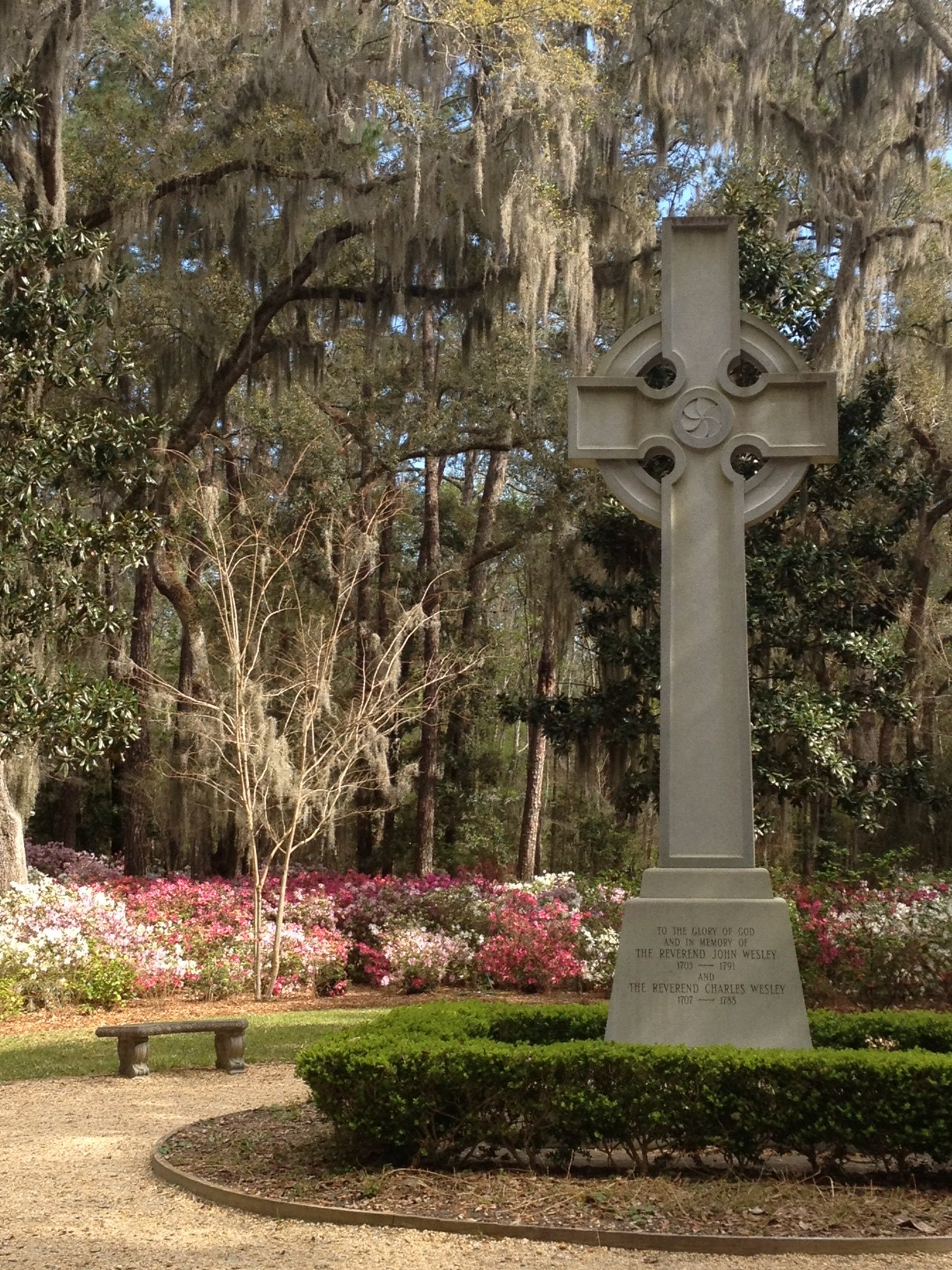
The Wesley Garden

The Wesley Garden. I stopped to pray and reflect here after dropping Sarah off for her mission trip today.

I think the greatest lesson we can learn this side of heaven is to pause and trust God that our worth and identity are not tied to what we do.  This is hard.  It is hard for me this summer.  But it is something we should all experience regularly.  The day will come for all of us when we will no longer be defined by what we do, who we are with, and what we produce.  Some of us enter that season kicking and screaming.  Others of us long for that day…until it arrives and we discover we don’t know how to live into an identity not defined by work or position.  Unfortunately, we never paused enough to realize who we are.

I continue to learn every day that I am defined by God alone.  Who I am and what I am worth are not rooted in a title, a job, a relationship, or what I produce.  It is humbling to see that  the world will continue to spin on its axis and God will still reign over all…even when I pause.  Trust grows when we pause.  Our vision clarifies when we pause…we see that God reigns over all (we forget that sometimes).  Our lives are changed when we pause…we become people of self-surrender rather than people of self-sufficiency.


Pause.

When is the last time you paused?

Amicable Breakups? “Win-Win” Schisms?

I recently saw this press release from a group of 80 United Methodist pastors and theologians who have decided that the United Methodist Church is beset with a crisis.

There are many others far smarter than I who are weighing in, but I thought I would add some reflections on a few things that stood out to me.  Toward the end of the release, it reads…

“While we are willing to consider many options, we wonder if it is not time for persons of good faith, representing the spectrum of theological positions within The United Methodist Church, to begin discussing ways to create a “win-win” scenario for the mental, emotional and spiritual well-being of everyone involved? In the manner that Paul and Barnabas chose to part amicably (Acts 15:39-41), can we not work for a way of parting that honors the sincerity of those with whom we differ and no longer brings pain to persons made in the image of God?”

At first glance, that sounds peaceful, kind, wonderful, and speaks to all those who may think it is time to part ways.  But I am left with a few questions…

Is this a crisis of the entire church, or is it just a crisis for certain groups within the church?  I ask this because most Methodists I know don’t spend a lot of time or energy on this “crisis” until they are together at general meetings or stirred into a froth by someone who lifts up the issue.  The vast Methodists I know in the local church are most concerned about living their faith in the midst of a variety of daily life issues.  They are busy discipling, loving, struggling, living in community, worshiping, praying, working, and wondering why we can’t find more ways to better love each other.  One of the reasons why I love being a local church pastor is that I don’t really think much about the general church unless I am at a general church meeting.  Most of my time is spent with real people and real issues, not the latest general church “crisis”.  What encourages me so much is that the social and moral issues we face are seen differently when a real person walks in the door of your church looking for relationships of love, grace, and mercy.  I have found, more often than not, Methodists are willing to embody grace to all people…even people they disagree with.  I’m not saying the issues don’t matter, but there are some who would have them be the central focus of all our conversation.  I don’t find that’s where most people are.

Is there really such a thing as a “win-win” scenario when it comes to church schism?  Can we really have an amicable breakup?  Common sense and experience dictate that every breakup I’ve ever been a part of devolves into mistrust and anger.  Have you actually ever been a part of an amicable breakup?  Maybe, but you know they are not the norm.  And when it comes to church history, there is no such thing as an “amicable breakup” or a “win-win” schism.  They don’t happen.  In college, I majored in religious history and religious studies and I don’t remember studying even one “win-win” church schism.  Most of the time the losing side was deemed heretical and excommunicated.  Just take a few moments and read the history of a few schisms on this page “Schisms in Christianity” on Wikipedia.  Schism is never pretty and hardly ever amicable.

The last point I will lift up is not so much a question, but an historical observation.  In almost every schism within the Christian church, there are never two sides sitting down and “amicably” working out all the details, coming to agreement, standing up at the end with a handshake and a smile and departing with two new churches.  That doesn’t happen.  Schisms in Christian history are never “win-win” scenarios.  There is never consensus.  There is no “HEART” principle.  In every single schism, there are winners and there are losers.  There are insiders and outsiders.  There are conquerors and the conquered.  This is probably why Jesus and Paul both lifted up the importance of the unity of the Body.  How can you remove an arm or a leg and call it “win-win”?  No, schisms are messy and militaristic.  If we continue to move in this direction, which we may, it will be messy.  I believe it will do harm to many local churches by causing members to “choose” sides…making enemies of their brothers and sisters who sit next to them in the pew each Sunday.  That possibility grieves me!  Recently, we’ve seen this in Presbyterian Church (PCUSA) at First Presbyterian in Houston, Texas.  They fell a few votes of leaving the PCUSA denomination for ECO, a new denomination of conservative Presbyterians who feel the PCUSA is too liberal.  The failure of the vote has caused a rift in the church they may not recover from since the pastors and most leadership were in favor of leaving the PCUSA denomination for ECO.  I have and will continue to pray for First Presbyterian in Houston.  This cannot be an easy time for them.  As I said, schisms are not pretty.

I have always said that I believe our greatest witness is not in who wins or loses.  Our greatest witness to the world is “HOW” we disagree with each other.  The world will look at a church split and say, “how are they any different than any other earthly institution that doesn’t get what they want?”

But can you imagine the powerful witness if somehow we could exist together embodying grace, love, and mercy toward each other…even though we disagree?  Now that would change the world!

To embody grace to those who need it as we receive it…may it be so!

When Rules Get In the Way

The rules say you cannot help the homeless man.

One of the things I’ve always loved about Jesus’ ministry is how he dealt with rules.  Jesus was not exactly the “rebellious, rule-breaker” many hip pastors and youth ministers lift him up to be.  Jesus actually lived according to the laws of God celebrating the holy days and honoring the Sabbath.

But Jesus never let the rules get in the way of helping someone or loving someone.  Jesus knew the meaning behind the rules.  He knew the law was put in place to protect and convict all of us.  The law of God was there so that when we were confronted with a difficult decision, we would be protected when needed and we would assist when called upon.  Through the ages, like any good set of rules, they (the rules) became more important than the purpose behind them being rules in first place.

This is why Jesus healed on the Sabbath.  This is why Jesus fed his disciples on the Sabbath.  This is why Jesus would eat with those the rules said to not eat with.  When we forget why the rules are in place, the rules lose meaning.  The meaningless rules become a heavy burden on your back for reasons we have long forgotten.

I am glad Jesus “fulfilled” the law and reminded us of the purpose behind the rules.  I often use the phrase I learned from my grandmother, “we need to get the ox out of the ditch” when reminding myself and others that we must sometime go against the “rule” for a greater good.  The phrase comes from Luke 14:5 when Jesus asks, “which of you shall have an ass or an ox fallen into a pit and not immediately pull it out on Sabbath day?”

Antoine Turner just committed to Boise State to play football this fall.  His story is pretty amazing.  His mother died when he was very young.  He has been transient and homeless most of his life.  He is homeless now…and he will be a scholarship athlete at Boise State.  But until he actually registers for classes, he has nowhere to lay his head.  He talks about not even owning a blanket.

When the Boise State fans and alumni heard about Antoine, they responded with overwhelming generosity!  That is no surprise.  People want to help.  There is only one problem…the NCAA has rules against furnishing any kind of aid at all to student athletes.  Boise State could face sanctions if anyone helped Antoine.  And so, Boise State is telling everyone NOT to help their newest, homeless football player.

There is a part of me that almost wants to laugh at the lunacy, but we are talking about a young man who is homeless and who has been homeless most of his life.  That is no laughing matter.

Antoine will have housing and three square meals soon.  Hopefully, he will have a bright future with an education from Boise State!  In the meantime, what do we make of all of this?

This is an “ox in the ditch” situation.   I hope and pray the NCAA and Boise State will step up immediately and provide shelter and safety for Antoine Turner.  This is definitely a case of rules getting in way.

*****As of 1:30 EST, May 14, 2014, the NCAA gave approval to Boise State to provide immediate assistance to Antoine Turner.  The news came out as I was writing this blog post!  Thanks be to God!

Just Because You Don’t See Them Doesn’t Mean They’re Not There

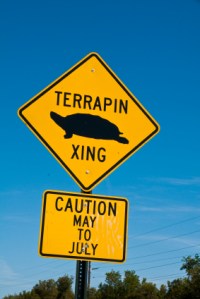
For the past five years, I’ve lived on the beautiful coast lands of Georgia…specifically St. Simons Island.  Everyday for five years, I go back and forth across the St. Simons causeway to visit the hospitals, take my kids to school, shop, play golf, or just visit.  And every time I travel across that cTerrapin Crossingauseway, I see this sign.  The sign warns me to be cautious.  I am warned to look out for terrapin turtles crossing the road.  They are endangered on the coast and we do all we can to ensure their survival.

Honestly, as many times as I’ve been across that causeway, I have never seen ONE terrapin crossing the road – even from May to July.  Nope, not one.  As a matter of fact, I haven’t even seen a dead terrapin that someone has run over.  Not one.

Based on my own personal experience, I might wonder a few things:

  1. Do terrapin turtles actually exist?
  2. Do terrapin turtles actually cross the road?
  3. When/If people run over a terrapin turtle, do they stop, pick it up, take it home and make soup?
  4. Are terrapin turtles amazingly more brilliant than we think and when they see a car coming they say to themselves, “are you kidding me? I’m not crossing the street now!”

I know terrapins exist.  I don’t know the answer to any of the other questions.  But here’s what I do know…

Biologists and scientists I know and trust on St. Simons and Jekyll Islands tell me that over 115 terrapins are killed each year by motor vehicles on the causeways from St. Simons and Jekyll Islands.  They do intensive studies and find the mostly female turtle carcasses along the causeways in their search for high, dry ground to lay their eggs along the roads.  A seriously endangered species with over 800 fatalities in the past 7 years on two short Georgia causeways.  I had no idea.

And in thinking about terrapins, I also thought about so many other things in my life that I never see…that I don’t really pay much attention to…that I think don’t matter…and yet when the dust settles, many of those thing matter deeply.  As a pastor, I should know that by now.  I see people everyday who ignore the signposts of life.  The signs caution us to speak kindly, love deeply, give generously if we really want to experience the fullness of life.  But we don’t see the immediate connection of our small actions, so we just keep driving down the roads of life focused on our own needs and concerns.  We ignore the signs at our own peril.  We begin to believe that if we don’t see the lives negatively affected by our neglect they must not exist.  Yet, all along the roads of our lives there may be the carcasses of friends, families, and our own well being.

Remember, just because you don’t see them, doesn’t mean they’re not there.

Just because we don’t see the harm done to others by our words and actions, doesn’t mean it isn’t there.

Just because we don’t see the fruit of a simple act of kindness, love, or generosity doesn’t mean they aren’t transforming the world around you.


A New Way to Look at Things

Colossians 3:1-4

So if you have been raised with Christ, seek the things that are above, where Christ is, seated at the right hand of God. Set your minds on things that are above, not on things that are on earth, for you have died, and your life is hidden with Christ in God. When Christ who is your life is revealed, then you also will be revealed with him in glory.

How we choose to see things plays a large part in how we live our lives.  Psychologists and sociologists will tell you that once we have certain basic needs met – food, health, clothing, and shelter – and once we have a minimal amount of wealth, all of the problems that follow after this are usually problems of perception.  Let me give you a few examples of how perceptions make all the difference.  Rory Sutherland shared these in a recent TED talk I heard while traveling.

In 18th century Prussia, King Frederick wanted to introduce the potato as the second staple crop in his kingdom.  Wheat was the primary staple, but Frederick knew that if something catastrophic happened and the wheat harvest was compromised, it would throw his kingdom into chaos.  The potato would give stability and safety.  The problem was no one in Prussia wanted the potato or knew what to do with it.  They refused even under orders to grow potatoes.  Frederick decided to change the way everyone looked at potatoes.  He named it the official food of the King and grew potatoes in the royal gardens under guards – but the guards were told not to guard the potatoes too well.  As any 18th century peasant knows, if it’s worth guarding, it’s worth stealing.  The peasants broke in and stole the potatoes.  Next thing you know, people are growing and eating potatoes.  Frederick didn’t change anything other than the way people perceived potatoes.

Do you know what the most valuable jewelry in Prussia in the first half of the 19th century was?  It was jewelry made of cast iron.  Why?  During the war with the French, people of means turned in their gold and precious jewelry to support the war.  In return, they were given replicas made in cast iron.  For 50 years after the war, the highest status jewelry you could wear in Prussia was cast iron.  It wasn’t about the actual intrinsic value of the jewelry, rather it was the deep, symbolic value cast iron jewelry had in Prussia.  It said your family made a great sacrifice for the cause of the war.  It was all about how they saw things….

Eurostar is a train that travels all across Europe.  It has a line from London to Paris under the English Channel.  Several years ago, they put $6 billion pounds or about $10 billion dollars investment in their infrastructure to increase travel time from London to Paris by about 40 minutes from over 3 hours to 2 hours and 30 minutes.  Why did they do this?  Because the business travelers felt it took too long.  They had a problem with the amount of travel time so Eurostar set out to “fix” the problem.  Their fix was technical, mechanical and expensive – $6 billion pounds worth of new tracks and trains.   They never stopped to think about how changing the perceptions could have saved a lot of money.   Rory Sutherland suggested the following:  For .1% of this money, you could have put free Wi-Fi on the train.  It would not decrease the travel time but it would have made the time more enjoyable and more productive for those traveling.  For .5 to 1% of the money, you could have paid all of Europe’s male and female super models to walk up and down the aisles handing out free Champagne to all the passengers.  They would have had almost $6 billion pounds left over and the passengers would have asked for the train to be slowed down.

Life only has two forms of value.  Tangible Value (things you can buy, touch, see, hold, control, fix, and build), and Intangible Value (things that are unable to be touched, grasped; things that do not have physical presence).

We were originally created to value INTANGIBLE things.  We are created in the image of God for relationship with God and for relationship with each other.  This is why the Great Commandment is “love of God and neighbor”.  It seeks to help us return to God’s original intent for our purpose.

The problem is ever since the Fall Sin caused us to seek value in TANGIBLE things (thus kingdoms and kings, conquering territories, war, power, gold, etc.).  Sin did this to us and it continues to do it to us.  When we seek Intangible Values, we set our minds on things that are above.  When we seek Tangible Values, we set our minds on things that are on the earth.    Seeking Tangible Values disconnects us from the original intent of our created purpose.  This is why we suffer so many disappointments in life.

The biggest limitation we face in our lives is that when we are confronted with conflict and struggle in life, we look for our solutions in tangible things: technology or economy.  If technology can’t fix the problem, then money can.  If money can’t fix the problem, then technology can.  We just try to change things, we rarely change the way we look at things.  Technology and money only buy us time…they don’t bring our lives into alignment with our created purpose.

In the movie, “The Sixth Sense” with Bruce Willis, the boy Cole says, “I see dead people.”  (That is the famous line!)  But what he says after that is even more chilling, “They don’t know they are dead.  They don’t see each other.  They only see what they want to see.”  In Colossians, Paul says we have been raised with Christ.  You and I have been raised!  We are no longer subjected to the powers of this world.  We are no longer limited by death or any other human limitation.    We have been raised, yet many of us continue to live as if we do not have access to that power…we live as dead people.  We only “see” things we want to see…things that perish and keep us down.

Why do we continue to look at the world through eyes of death and limitation?  Why is it so hard to change our perspective?  Through the Resurrection, we are defined by the Risen Christ.  And our definition in Christ calls us to gain a proper perspective of this world.  We do not raise ourselves; we are raised by being united with Christ.  And if you have been raised with Christ, then you are now able to seek the things differently.  Everything is different for those of us raised in Christ, and we can experience all things new if we can set our minds on the things above.

Two recent experiences make this real for me…

There is a man who was diagnosed of terminal cancer in January.  He was given only a month to live.  He had no time left at all, but he kept going and going.  No one could figure out why until they asked him.  He wanted to make it to his sobriety birthday in April and receive his 13 year sobriety chip.  After he received it and went home, he asked a friend, “What do I do now?”  His friend said, “You can go now.”  He died two days later.  Talk the power of setting your mind on things above…

Another young man I know almost died from drugs.  Why?  He chose the wrong friends.  Why did he choose the wrong friends?  He doesn’t see himself as valuable and precious.  He sees himself as unworthy.  And by seeing himself as worthless, he got into the wrong friends and the wrong life and it almost killed him.  He is turning his life around and beginning to see himself differently.  I told him, “You are loved and precious.  You’ve got to believe it and know that it is true.  Get around good friends who can reinforce it.  You’ve got to see your life differently.”  I got a text from him at 6 a.m. this morning.  It said, “Happy Easter, because of today years ago, I know I am forgiven of all my sins.”  Talk about the power of setting your mind on things above…

Christ is Risen and YOU have been raised with Christ!  The power is yours.  Claim it by setting your mind on things above.  See the world differently – through the eyes of the Risen Lord.

Will Jesus Hide From Us?

John 12:20-36
 20Now among those who went up to worship at the festival were some Greeks. 21They came to Philip, who was from Bethsaida in Galilee, and said to him, “Sir, we wish to see Jesus.” 22Philip went and told Andrew; then Andrew and Philip went and told Jesus. 23Jesus answered them, “The hour has come for the Son of Man to be glorified. 24Very truly, I tell you, unless a grain of wheat falls into the earth and dies, it remains just a single grain; but if it dies, it bears much fruit. 25Those who love their life lose it, and those who hate their life in this world will keep it for eternal life. 26Whoever serves me must follow me, and where I am, there will my servant be also. Whoever serves me, the Father will honor.

27“Now my soul is troubled. And what should I say—‘Father, save me from this hour’? No, it is for this reason that I have come to this hour.28Father, glorify your name.” Then a voice came from heaven, “I have glorified it, and I will glorify it again.” 29The crowd standing there heard it and said that it was thunder. Others said, “An angel has spoken to him.” 30Jesus answered, “This voice has come for your sake, not for mine. 31Now is the judgment of this world; now the ruler of this world will be driven out. 32And I, when I am lifted up from the earth, will draw all people to myself.” 33He said this to indicate the kind of death he was to die. 34The crowd answered him, “We have heard from the law that the Messiah remains forever. How can you say that the Son of Man must be lifted up? Who is this Son of Man?” 35Jesus said to them, “The light is with you for a little longer. Walk while you have the light, so that the darkness may not overtake you. If you walk in the darkness, you do not know where you are going. 36While you have the light, believe in the light, so that you may become children of light.” After Jesus had said this, he departed and hid from them.

Close your eyes for a moment…be still and quiet.

While your eyes were closed, what did you ‘see’?  You might say, “Are you crazy? I didn’t see anything. You told me to close my eyes!”  Some of you may say, “I saw my son,” or “I saw my mother,” or “I saw my sister whose husband just passed away.”  One of the most important lessons we learn in life is summed up in a quote from the Little Prince by Antoine de Saint-Exupéry, “It is only with the heart that one can see clearly. What is essential is invisible to the eye.”

I am struck by this Holy Week passage, particularly how it begins and how it ends.  The Passover festival begins and we find some Greeks who are coming to the festival seeking Jesus.  They approach Philip and say, “Sir, we wish to SEE Jesus.”  The word used here for “the Greeks” is different than what the Gospels usually use for Gentiles.  This leads some scholars to believe these are Hellenistic Jews, not Gentiles.  They are coming to the Passover and have probably heard of Jesus.  Just like any good tourist, they wish to see the sights and Jesus is a main draw.  Whether it was simple curiosity or a sincere search for truth, we don’t really know. All we know is they wish to see Jesus.  As Philip and Andrew tell Jesus of the Greeks’ curiosity, Jesus begins to share really odd things.  He talks of dying seeds, a life that will be lost, a troubled soul, and the lifting up of the Son of Man after death. In the midst of it all a thunderous voice of God is heard by all, but only the readers of John are given insight to what the voice says.  After all of this cryptic language, Jesus says, “The light is with you for a little longer. Walk while you have the light, so that the darkness may not overtake you. If you walk in the darkness, you do not know where you are going. While you have the light, believe in the light, so that you may become children of light.”  Then the passage ends with Jesus departing and hiding himself from them.

They wish to see, but Jesus hides himself.

This past Palm Sunday in Kansas City, Kansas, an admitted racist and anti-Semite (one who admits hatred for Jews) was charged with the murder of three people – a boy and his grandfather outside a Jewish community center, and a woman from a Jewish assisted living center.  The Jewish Community Center and Retirement Community was named Village Shalom – which in Hebrew means “peace”.  Hatred, racism, murder, all things born in the darkness found their way into the light of day through a disturbed man.  The man who committed these atrocious acts was blinded by darkness.   And the disturbing irony of the power of darkness?  The three people who were murdered at the Jewish Center…they were all Christians.

The disturbing and disastrous power of darkness.  Mark Twain once said, “One cannot depend on the eyes, when one’s imagination is out of focus.”

This Holy Week, we are once again challenged to live in the tension between darkness and light.  Jesus, the light of the world, confronts the ultimate powers of darkness during Holy Week…misguided perceptions, preconceived notions, cultural powers, sin, and death.  Holy Week brings to the surface the universal conflict between darkness and light, blindness and sight, unbelief and belief.

So where do we fit in all this?  Like the Greeks, many of us continually seek Jesus.  We want to be close.  We want to see and be a part.  Then, Jesus starts talking about death and sacrifice and other things that disturb…and we are not really sure what to make of “that” Jesus.  Where is the Jesus who blessed the children?  Where is the Jesus who fed 5,000?  Where is the Jesus who said “give me your burdens”?

I’m not so sure about this Holy Week Jesus who speaks of death, sacrifice, humility, and suffering.

If we are honest, we will see ourselves in the Greeks who seek Jesus.   We are seekers, but the Jesus we seek during Holy Week is untamable and uncontrollable.  This Son of Man challenges our beliefs, our worldview, our bigotry, our selfishness, our self-righteousness, and our lack of commitment.  This Son of Man calls us to die to the darkness and walk in the light.  If we assume too much and refuse to see the darkness in us, we may find that Jesus is hidden to us.

That’s what the text says, “he departed and hid from them.”  Live in the darkness and you will not see.  Turn away from the light and Christ will be hidden from you.

Marcel Proust said, “The real voyage of discovery consists not in seeking new landscapes, but in having new eyes…”

Walk in the light…that the darkness may not overcome you.  If there ever was a week to reflect on the power of darkness in our lives, it is this week.

Which Comes First? Happiness or Gratitude?

I listened recently to a great podcast by Benedictine monk Brother David Steindl-Rast as he wrestled with the topic of gratefulness.  What is the connection between happiness and gratefulness?  Some people think happiness comes before gratitude.  But, we all know people who have a lot of things to be grateful for, yet they are unhappy.  We also know people who don’t have much at all or they suffer misfortune, yet they radiate happiness.  So which comes first?

Brother David declares, “It is gratefulness that makes us happy.  Happiness does not make us grateful.”

Gratitude comes when something valuable is given to us as a gift.  Gratefulness comes first in response to the gift, then happiness follows.  We can all understand gratitude when given a great gift, but what about every moment of every day?  How do we live gratefully?  We must become aware that every moment is a “given” moment – a gift given to you.  We have no way to be sure that another moment will be given!  Every moment is a new gift!  As you reflect on the beauty of each moment given, we become more grateful for life and we discover happiness.

Are we grateful for everything in life?  No.  There are things like war, violence, misfortune, and oppression that we are not grateful for, but Brother David doesn’t say we are to be grateful for everything…he says we are to be grateful  in every given moment.  Even when confronted with difficulty, we can rise to the moment  and become grateful to learn patience, to learn endurance, and to learn love.

If we want to live gratefully in every moment, Brother David says we must…”Stop, look, and go”.

We don’t stop enough in life. We must be quiet.  We need more stop signs in our lives.  When we stop, we invite opportunities of joy…we begin to ‘look’ and see more to be grateful for in life.  If you are grateful, you are not fearful.  When we are grateful, we act out of a sense of “enough”.  When we are grateful, we respect those around us.

I am grateful for this lesson from Brother David.  It made me happy.  I thought I would share.  A grateful world is a world of joyful people!

Hearts United – Father Daughter Weekend

Sunday morning...beach was empty.  Hopefully they were in church!

Sunday morning…beach was empty. Hopefully they were in church!

“I will always love you.  I will never lie to you.  Always listen to my voice.”

Those three statements where whispered in my daughter’s ear as we began our trust walk.  Sarah Mac, my 16 year old daughter, was blindfolded and it was my job to help navigate her through the woods near the Satilla River.  The first third of the walk I could put my hands on her shoulders to guide her and give her direction.  The middle of the walk I could only use my hands on her shoulders to guide her…I couldn’t speak.  The final third of the walk I was not allowed to guide or speak.  I could only assist IF Sarah asked for help.  When she would ask, I could answer her questions.  Along the way, some of the leaders would try to encourage Sarah to go the wrong way.  She would ask if they were telling the truth.  They weren’t, of course.

At the end of the walk, we debriefed.  We talked about our fears and feelings.  As I reflected, I quickly became aware that the trust walk in the woods near the Satilla River really wasn’t very scary at all.  If Sarah ran into a tree (as horrible as that sounds) we could simply clean her up and put a bandage on her scrape.  The real fear came in knowing that as a father I won’t always be there to guide or even answer her questions when she asks.  If she is confronted with a challenge in life, will she stop and take time to call me and ask.  Not always.  I know that and you do too.  That’s why its so important to take seriously each and every modeling moment in life.  They truly matter!  We always wonder, have we done enough?  Have we given her enough resource, knowledge, and direction?

There are many hard parts of parenting.  As we move into the final two years of high school, you look back over the past 16 years and wonder, “Have we done enough?”  This requires a tremendous amount of trust.  I’m not sure many parents don’t wonder about the same thing.  Even if we are concerned, the reality is we can’t make up in two years what we haven’t done in 16.  Not only is it nearly impossible to impart that knowledge in that time frame, the biggest obstacle is that your 16, 17, or 18 year old is not as receptive to those lessons now as they would have been at 7, 8, or 9.

Our girls.  We were the Rosie Riveters team.  Don't ask...

Our girls. We were the Rosie Riveters team. Don’t ask…

Our weekend together was special and it really helped us to see how important our bond is.  No matter how strong our relationship, there are always struggles.  The Hearts United Father Daughter weekend reminded me of two amazing and invaluable lessons:

  1. There is no substitute for intentional time set apart in relationships.  The old debate of quality vs. quantity is very simple.  It is hard to achieve depth of quality without time.  We must be intentional about the time we carve out with our children.  I know there are situations that prevent us from sharing the time we would like (for example, several dads on the weekend are divorced and only see their daughters once per week or every other weekend).  We have to do whatever we can to make that time happen.  There is no substitute for time.  The greatest gift of the weekend is that it forced me to carve out my entire weekend and devote it to my daughter.  I wouldn’t have traded it for anything!
  2. Children need encouragement.  Our children long for encouragement from their parents.  My daughter longs for encouragement from me.  I realized that I need to do a better job with my words of encouragement.  The Losada Ratio proves this to be true.  If you want your family to flourish, you must speak 5 words of encouragement for every word of criticism.  This ratio leads to a flourishing life.  Less than that leads to a languishing life.  More than anything, I want my daughters to flourish!
Sunday morning on the beach.

Sunday morning on the beach.