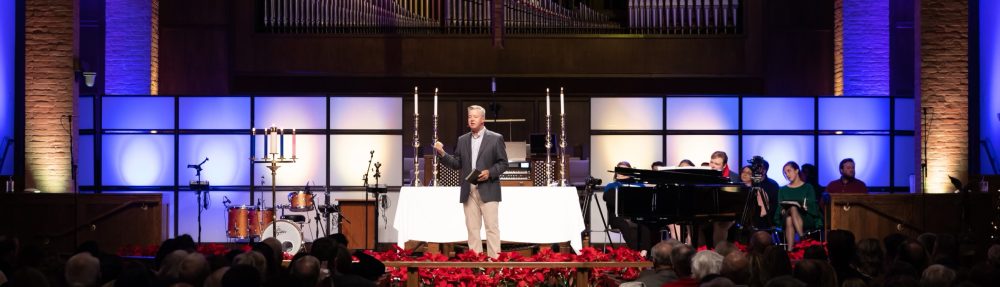
Here For A Reason

Matthew 25:31-46
31“When the Son of Man comes in his glory, and all the angels with him, then he will sit on the throne of his glory. 32All the nations will be gathered before him, and he will separate people one from another as a shepherd separates the sheep from the goats, 33and he will put the sheep at his right hand and the goats at the left. 34Then the king will say to those at his right hand, ‘Come, you that are blessed by my Father, inherit the kingdom prepared for you from the foundation of the world; 35for I was hungry and you gave me food, I was thirsty and you gave me something to drink, I was a stranger and you welcomed me,36I was naked and you gave me clothing, I was sick and you took care of me, I was in prison and you visited me.’ 37Then the righteous will answer him, ‘Lord, when was it that we saw you hungry and gave you food, or thirsty and gave you something to drink? 38And when was it that we saw you a stranger and welcomed you, or naked and gave you clothing? 39And when was it that we saw you sick or in prison and visited you?’ 40And the king will answer them, ‘Truly I tell you, just as you did it to one of the least of these who are members of my family, you did it to me.’ 41Then he will say to those at his left hand, ‘You that are accursed, depart from me into the eternal fire prepared for the devil and his angels; 42for I was hungry and you gave me no food, I was thirsty and you gave me nothing to drink, 43I was a stranger and you did not welcome me, naked and you did not give me clothing, sick and in prison and you did not visit me.’ 44Then they also will answer, ‘Lord, when was it that we saw you hungry or thirsty or a stranger or naked or sick or in prison, and did not take care of you?’ 45Then he will answer them, ‘Truly I tell you, just as you did not do it to one of the least of these, you did not do it to me.’ 46And these will go away into eternal punishment, but the righteous into eternal life.”

Matthew’s depiction of the last judgment today, is like a wellness check. It is not seeking to condemn or scare you, but to provide an overall picture of the health of your spiritual life. Just as your doctor wants you to be healthy, your Creator wants you to flourish in this life.  And so we have the ONLY image in the New Testament of the final judgment. Jesus comes in all his glory and gathers ALL THE NATIONS – as referring to all people everywhere and throughout time.  This image of judgment causes some question for many. There is no lifting up of faith in this judgment. Only actions. What you did…to the LEAST of these, you did to Christ. It seems that you and I are called to not ignore and overlook, but to look into a human face and to see there the face of Jesus Christ, because that is what he said.

The first idea in this passage is a statement about God. The God of Jesus, the God of the Bible, is not a remote supreme being on a throne up there above the clouds or out there somewhere in the mysterious reaches of the universe. Jesus said, God is here, in the messiness and ambiguity of human life. God is here, particularly in your neighbor, the one who is in need around you. You want to see the face of God? Look into the face of one of the least of these, the vulnerable, the weak, the children.  If you were here a couple of months ago and heard the testimonies of our youth who went to Peru, you would know they saw Christ in the face of those young children. If you talk with members of our church who work at Manna House or work on Wolfe Street, you will hear that they often see the face of Christ in the face of those in need. Not always, but in the least of those they minister to. God is among us.

The second statement is about the practice of our religion. You cannot read the paper and not be concerned about the role religion plays in the world. Terrible atrocities are committed by people shouting, “God is great.” Religious officials hide clergy abuse, deny sacraments to those with whom they disagree. Religious leaders condemn each other, excommunicate each other, invest inordinate amounts of energy and resources fighting one another over who gets in and who is kept out, over whose doctrinal formulas are true and whose are false—over a whole laundry list of issues about which Jesus had absolutely nothing to say. He did, however, say this: “When you did it to one of the least of these, you did it to me.” There is nothing in this judgment about church connections or religious practices. There is not a word in this passage about theology, creeds, orthodoxies. There is only one criterion here, and that it is whether or not you saw Jesus Christ in the face of the needy and whether or not you gave yourself away in love in his name.  As Edgar Guest’s famous poem begins, “I’d rather see a sermon than hear one any day. I’d rather one should walk with me than merely tell the way.”
The third most important idea in this passage is personal. God wants not only a new world modeled on the values of Jesus. God wants us—each of us. God is not a social engineer but a God of love who wants to save our souls, to use the language of the old revival meetings. God wants to save our souls and redeem us and give us the gift of life—true, deep, authentic human life. God wants to save us by touching our hearts with love. God wants to save us by persuading us to care and see other human beings who need us. God wants to save us from obsessing about ourselves, our own needs, by persuading us to forget about ourselves and worry about others. That is God’s favorite project: to teach you and me the fundamental lesson, the secret, the truth—that to love is to live generously.

How we choose to live and respond to the least of these makes a difference. Jesus is very clear here. Those who think there are no consequences to actions are mistaken. In a world that seems too big to be changed, our lives have more meaning and value than we imagine. Our choices are not the only shapers of the future. They are, however, critical.

Saints and Stewards

Matthew 5:1-12
When Jesus saw the crowds, he went up the mountain; and after he sat down, his disciples came to him. 2Then he began to speak, and taught them, saying:
3“Blessed are the poor in spirit, for theirs is the kingdom of heaven.4“Blessed are those who mourn, for they will be comforted. 5“Blessed are the meek, for they will inherit the earth. 6“Blessed are those who hunger and thirst for righteousness, for they will be filled. 7“Blessed are the merciful, for they will receive mercy. 8“Blessed are the pure in heart, for they will see God. 9“Blessed are the peacemakers, for they will be called children of God. 10“Blessed are those who are persecuted for righteousness’ sake, for theirs is the kingdom of heaven. 11“Blessed are you when people revile you and persecute you and utter all kinds of evil against you falsely on my account. 12Rejoice and be glad, for your reward is great in heaven, for in the same way they persecuted the prophets who were before you.

All Saints Sunday always gets me thinking about my grandmother, my Memaw as we call them down here in the South. She was a simple woman who grew up in North Carolina and married a soldier. Settled in Columbus, Ga to be near Ft. Benning in their retirement. My Memaw wasn’t a highly educated woman, but she was smart. She had great sayings like, “You can’t fix stupid.” And my favorite, “There’s nothing worse than pretentiousness…but there is nothing better than well done pretentiousness.” A collection of homespun wisdom and keen observation. A woman of deep faith.

The Beatitudes are a reflection of a deep faith and they draw our attention to the Saints of God today. Saints are not perfect, you know that, but they made a deep and profound impact on our lives and in our world. You don’t have to be Mother Teresa to be a Saint. You can just be Memaw. The key is, do you live the kind of faith reflected in the Beatitudes?

Charles James Cook, who is Professor Emeritus of Pastoral Theology, Seminary of the Southwest, Austin, Texas, shares a unique way of looking at the Beatitudes.

We might find them more helpful if we looked at them as a whole, instead of individually. Those who are meek for example, meaning humble, are more likely to hunger and thirst for righteousness, because they remain open to continued knowledge of God. In this way, they become much more practical for our lives.  Professor Cook goes on to say there are three simple rules for living found in the Beatitudes – simplicity, hopefulness, and compassion. If I look at them from this perspective, I can see that my grandmother and so many other Saints who have gone before us lived these Beatitudes…and now I know we can too.

Simplicity is not a lack of sophistication. It is rather hearing the words, seeing the truth as it is and heeding it. Take things for what they are, not as we want them to be. If we can hear these words of Jesus as simple words, “Blessed are you when you demonstrate humility, bring a peaceful presence to wherever you are, open your heart to others, and show mercy to those who need it. Those are not sophisticated, hard to accomplish Beatitudes. They are simple rules for living. Saints live simple lives.

Hopefulness. We can certainly agree there is not enough hope in the world. I fall into the trap of becoming overly cynical about things in life and cynicism is not good. Cynicism decides to just accept whatever is and offer no hope that it will get better. I see that in me from time to time and I don’t want that to be who I am! Beatitudes invite us to hopefulness because Jesus lived in hope. We must live and work with the surety that mercy, humility, peace, and love are possible in our lives. Saints live hopeful lives.

Compassion is not just pity or sympathy. Pity feels sorry. Sympathy is understanding and offering advice. Compassion is when you recognize that those around you share your humanity! We are not separate – we are one! Compassion is not walking the same path, but carrying them – walking in their shoes. Saints live compassionate lives.

These Saints today were stewards of the gifts they were given. They weren’t perfect, no Saint is. But they reveal to us the connection we share with God and with one another. We are called to be a light to the world. We are called to live the Beatitudes as real and practical rules for life. We are called to be the Saints of God.

The Witness of Unity

John 17:20-26
20”I ask not only on behalf of these, but also on behalf of those who will believe in me through their word, 21that they may all be one. As you, Father, are in me and I am in you, may they also be in us, so that the world may believe that you have sent me. 22The glory that you have given me I have given them, so that they may be one, as we are one,23I in them and you in me, that they may become completely one, so that the world may know that you have sent me and have loved them even as you have loved me. 24Father, I desire that those also, whom you have given me, may be with me where I am, to see my glory, which you have given me because you loved me before the foundation of the world. 25“Righteous Father, the world does not know you, but I know you; and these know that you have sent me. 26I made your name known to them, and I will make it known, so that the love with which you have loved me may be in them, and I in them.”

We just celebrated World Communion Sunday on the first Sunday of October.  On that day, we lifted up our unity as Christians in the church universal by sharing the sacrament of Holy Communion along with thousands of other Christians worldwide.  There is an urgent need right now for Christians to be a witness through unity, especially in our American political climate.  First and foremost, Christians are fundamentally called to demonstrate our faith guided by Jesus Christ. Unfortunately, during this season of presidential politics many of us seem to guided more by our commitment to political ideologies than the teachings of Christ.

Let me give you two examples.

I have a good friend who is a Christian and a Democrat. She started visiting a new church in the community where she lived.  While she thought her faith and politics lined up, she learned very quickly that the people in her new church did not agree.   In a Sunday school class conversation, several seemed to imply (and one person directly stated), that one cannot be both a Christian and a Democrat. She liked her church and knew everyone did not feel this way, but here she was in a congregation where leaders of her class were telling her that her political views were not Christian. What kind of church would say such things?

I know another man who shared with me his pain around faith and politics. He is a Christian as well and a faithful member of his church. He never told me his political affiliation, but he expressed some deep pain from friends and congregation members who sent out partisan emails. He is the kind of guy who studies the facts and whenever he would try to point out the errors of certain emails (of which most were partisan lies), the response back to him was not exactly in keeping with the kind of love Jesus modeled. They responded to him harshly and he had not even asked to be sent those emails! Someone just included him in all the FWDs. One man said to him, “Don’t talk to me anymore!” What kind of church would say such things?

Actually, both of these people attend the same church.  And the church these two people attend is the church I pastor.

I appreciate some aspects of both parties and disagree with others. I have voted for persons in both parties. Jesus would not perfectly fit either political party. The truth is we Christians have damaged our witness when it comes to how we participate in partisan politics.  I know many people of strong faith who become very un-Christian in their behavior when they begin to talk about politics.

In John’s gospel today, Jesus is talking about unity. As we gather around the table to celebrate the sacrament of Holy Communion, we celebrate unity in the Body of Christ. Our faith teaches that we are one body and Christ is the head. This does not mean we are all the same or that we all see the world the same way. We struggle in our differences; I get that – I struggle as well. But we must remember that just because we are commanded to be ONE doesn’t mean we have to all be the SAME.  Unity is not the same as uniformity.  In this section of the gospel of John, Jesus teaches us that our unity is rooted in our faith and that our witness to the world will not be about “right belief” but rather about “right living” – Jesus models the Father, and he calls us to model him. Our love of God and one another, if it is true and authentic, should rise above any difference in our political ideology.

Let me encourage you to be a faithful witness to the love of God in these coming days and weeks. Remember the teachings of Paul from Ephesians 4, “Let no evil talk come out of your mouths, but only what is useful for building up, as there is need, so that your words may give grace to those who hear. And do not grieve the Holy Spirit of God…. Put away from you all bitterness and wrath and anger and wrangling and slander, together with all malice, and be kind to one another.”
I want you to be involved and engaged in the political arena, but I want you to remember that you are an ambassador of Christ first and foremost. Our faith should not be trumped by our loyalty to a political party. If it is, we compromise our witness to the world.

Are you a witness to the cosmic power of Christ in our unity? Or is your witness of Christ compromised by our lack of love and unity?

I Believe in Life Everlasting

Revelation 21:1-6, 22:1-5
21Then I saw a new heaven and a new earth; for the first heaven and the first earth had passed away, and the sea was no more.2And I saw the holy city, the new Jerusalem, coming down out of heaven from God, prepared as a bride adorned for her husband. 3And I heard a loud voice from the throne saying, “See, the home of God is among mortals. He will dwell with them as their God; they will be his peoples, and God himself will be with them; 4he will wipe every tear from their eyes. Death will be no more; mourning and crying and pain will be no more, for the first things have passed away.” 5And the one who was seated on the throne said, “See, I am making all things new.” Also he said, “Write this, for these words are trustworthy and true.”6Then he said to me, “It is done! I am the Alpha and the Omega, the beginning and the end. To the thirsty I will give water as a gift from the spring of the water of life.

22Then the angel showed me the river of the water of life, bright as crystal, flowing from the throne of God and of the Lamb 2through the middle of the street of the city. On either side of the river is the tree of life with its twelve kinds of fruit, producing its fruit each month; and the leaves of the tree are for the healing of the nations. 3Nothing accursed will be found there any more. But the throne of God and of the Lamb will be in it, and his servants will worship him; 4they will see his face, and his name will be on their foreheads. 5And there will be no more night; they need no light of lamp or sun, for the Lord God will be their light, and they will reign forever and ever.

Several years ago, after my father died, we took his ashes to be scattered over my grandfather’s family’s grave plot behind Zion Hope Baptist Church in Crisp County, Georgia. The scattering of my father’s ashes was not what affected me as much as looking around and seeing all these tombstones of men and women dating back to the early 1900’s…all with my last name. There was even a Corporal John Stephens, a soldier who fought under both General Joseph Johnson and General John Bell Hood as the Union General Sherman marched from Chattanooga to Atlanta.  My grandfather told me that was his grandfather’s brother and died at home after the militia disbanded with the fall of Atlanta. Being at that cemetery and hearing my grandfather tell of his grandfather and their families gave me a sense of history about my own life. There is something powerful about knowing where you come from.

My grandfather, Rome Stephens (I called him Coach), told me of his childhood in Fitzgerald, Georgia and how all the businesses would close at noon and how he and his father would go fishing most afternoons. He shared about how my great-grandfather died in 1937 at 57 years old of a heart attack while at work. My grandfather was 15 at the time.  Coach also shared with me that at his wedding to my grandmother Edna when the minister asked if anyone had any reason why these two should not be married my great-grandfather on my grandmother’s side stood up and said, “He didn’t ask me if he could wed my daughter.” My grandfather was frozen in fear as silence gripped the house. My grandmother looked at my grandfather and the preacher and said, “Don’t pay any attention to him, he’s kidding around.”  That helps to explain a lot about my sense of humor.

Stories that tell us where we come from are stories of origin.  They have tremendous power to help us understand where we came from and why we are here. But stories of origin have counterparts: stories of destination.  Stories of destination tell us where we are going.  As meaningful as our stories of origin are our stories of destination are more powerful, shaping force.  Stories of destination point to ultimate destiny. They answer the question “Where are you going?” in a much broader sense: Where are you headed? In what direction is your life taking you? What is your true destination? Such stories are the counterpart of stories of origin.

The book of Revelation is a story of destination just as Genesis is a story of origin. The common center in both our stories of origin and destination is God – God is the center of both our stories of origin and our stories of destination.

The stories of my past are not the stories that give me hope…they merely help me understand who I am in the present. The stories that give me hope in the present are stories of where I am headed. Belief in “The resurrection of the body” is a powerful statement of hope to me and all of us who see our bodies failing and wasting away day by day. There is something deeply comforting to know that as my body breaks down and grows old, that in the end, I will receive a new body.
The reason why this last line is in our Apostle’s Creed each week, is to reconnect with our story of destination – we are headed somewhere particular. We are headed back to God. In the end, we will dwell with God just as we did in the beginning before the fall. God is the beginning and God is the end.

As we have journeyed through the Apostle’s Creed, we have been confronted with our core beliefs that we recite each week. Here, in the final line of the Creed, we are met with our story of destination. It is appropriate that the Creed begins with our story of origin and ends with our story of destination.

The Apostle’s Creed reflects our faith, but it does much more. It forms us each week because it gives us both our story of origin and our story of destination – and everything in between!

I Believe Jesus Was Born, Suffered, and Died

Hebrews 2:14-18

14Since, therefore, the children share flesh and blood, he himself likewise shared the same things, so that through death he might destroy the one who has the power of death, that is, the devil, 15and free those who all their lives were held in slavery by the fear of death.16For it is clear that he did not come to help angels, but the descendants of Abraham. 17Therefore he had to become like his brothers and sisters in every respect, so that he might be a merciful and faithful high priest in the service of God, to make a sacrifice of atonement for the sins of the people. 18Because he himself was tested by what he suffered, he is able to help those who are being tested.

I will never forget my former seminary professor, Bill Mallard, sharing how he went to a friend’s house after her husband had been killed in a car accident far too young in Atlanta.  Knowing Bill was a theologian, in her tears the grieving wife asked him, “Where is God in this?”  Bill’s responded, “God is here with us…and God is weeping.”  That has stayed with me and echoed in my heart more times than I care to recall.  As a pastor, I am blessed to share so many wonderful and life-giving moments with people.  I also share many painful and terrible moments.  Many times I have shared Bill’s words with others.  Often, I have had to say those words in my car on my ride home…not for others…but for me.

We declare each week in the Apostle’s Creed that Jesus is Lord, declaring Christ’s divine nature.  We also declare that Jesus was born, suffered, crucified, died and buried.  This expresses his human nature.  In Christ’s divinity, his death and resurrection have cosmic significance, able to restore and redeem all of humanity and all of creation.  In his humanity, his death on the cross is real and personal.  Christ has shown each one of us the way to salvation, and because he died and his body was resurrected, he has conquered the enemies of sin and death.  In Christ’s humanity, we see that God became one of us. “Born of the Virgin Mary” is not so much about the Virgin Mary as it is about “being born!”  Birth connotes flesh and life.  Jesus was born of a mother just as we were.  Considering the horrific nature of humanity, the fact that God chose to become one of us is remarkable.  Jesus even proudly called us brother and sister.  God has become a human being, which means that, in a strange and wonderful way, God is with us.

In Christ’s humanity, God is one with us in our suffering.  God is with us in the midst of our sorrow: in the midst of tragedy and pain; in the midst of our illness and our grief. One of the most powerful images in the New Testament is the image of Jesus weeping with Mary and Martha at the tomb of his friend Lazarus.  Whatever theologians may say about the reason Jesus wept, the reality is he wept.  Weeping is not something we traditionally associate with God.  Jesus is God in the flesh and in every way shared in our sufferings.  No longer is our suffering something that we endure alone; Christ is in it with us.  Just as Christ embraced his own suffering, he now embraces us in ours.

Thomas Merton, in No Man Is an Island, wrote, “Suffering can only be consecrated to God by one who believes that Jesus is not dead. And it is of the very essence of Christianity to face suffering and death not because they are good, not because they have meaning, but because the Resurrection of Jesus has robbed them of their meaning.”

Merton goes on to say that suffering will come to us in life and put a question to us.  Suffering will ask us, “Who are you?”  When that happens, we must be ready to declare our own name and by that Merton means we must express the very depths of what we are, what we have desired to be, what we have become. He writes, “If we live as Christians, our name and our work and our personality will fit the pattern stamped in our souls by the sacramental character we wear. We get our name in baptism. That is because the depths of our soul are stamped, by that holy sacrament, with a supernatural identification which will eternally tell us who we were meant to be. Our baptism, which drowns us in the death of Christ, summons upon us all the sufferings of our life: their mission is to help us work out the pattern of our identity received in the sacrament. If, therefore, we desire to be what we are meant to be, and if we become what we are supposed to become, when suffering comes forth to questions us it will call forth from us both our own name and the name of Jesus. And we will find that we have begun to work out our destiny which is to be at once ourselves and Christ.”

In suffering we may find ourselves closer to Jesus, because he suffered as we do and knows the nature of suffering.

Finally, in Christ’s humanity, we have been liberated from the fear of death.  Christ endured suffering to death on the cross. His resurrection and ascension make plain that death is not victorious. Death no longer holds the power over us that it did before. Through the suffering of Christ, now all suffering is transformed. Death has lost its sting.  This reminded me of a question Billy Graham was recently asked, “Are you afraid to die?”  His reply was, “I am not afraid of death.  I am afraid of the process of dying, but I do not fear death because Christ has given us victory over death.”

The humanity of Christ is central to our faith.  We declare it every week in the Creed.  We declare it every moment in our suffering, knowing no matter what we face.  “God is with us. And he understands our pain.”

I Believe in Jesus Christ, the Lord

John 1:1-18

1In the beginning was the Word, and the Word was with God, and the Word was God. 2He was in the beginning with God. 3All things came into being through him, and without him not one thing came into being. What has come into being 4in him was life, and the life was the light of all people.  5The light shines in the darkness, and the darkness did not overcome it.6There was a man sent from God, whose name was John. 7He came as a witness to testify to the light, so that all might believe through him.8He himself was not the light, but he came to testify to the light. 9The true light, which enlightens everyone, was coming into the world. 10He was in the world, and the world came into being through him; yet the world did not know him. 11He came to what was his own, and his own people did not accept him. 12But to all who received him, who believed in his name, he gave power to become children of God, 13who were born, not of blood or of the will of the flesh or of the will of man, but of God. 14And the Word became flesh and lived among us, and we have seen his glory, the glory as of a father’s only son, full of grace and truth.  15(John testified to him and cried out, “This was he of whom I said, ‘He who comes after me ranks ahead of me because he was before me.’”)16From his fullness we have all received, grace upon grace. 17The law indeed was given through Moses; grace and truth came through Jesus Christ. 18No one has ever seen God. It is God the only Son, who is close to the Father’s heart, who has made him known.

In the late 18th century, Nicolas de Chamfort made an insightful statement that has since been attributed to many famous people.  He said, “One would risk being disgusted if one saw politics and one’s dinner in the making.”  I would add this statement could equally be used to describe in the assembling of Christian theology.

The Southern Baptist Convention has just formed a new committee and you will be amazed what it is for…  Right now Southern Baptists are struggling with what they believe about how salvation happens.  The number of Calvinists in the Southern Baptist church is growing.  Calvinists believe God predetermines who is going to heaven and who is going to hell.  One’s personal decision doesn’t have anything to do with salvation.  One the other side, the majority of Southern Baptists still believe that people must accept Jesus into their hearts to be saved – it is a decision one must make.  As they are talking about these two positions, there have been some problems.  Rather than lovingly discuss theology, there have been personal attacks and political subterfuge.  The new committee they just formed?  You might think it was formed to spell out their theology.  No.  It was formed to help them figure out how the two sides can get along in order to even discuss the topic.  Unfortunately, this is how Christian theology has always been done.

The creed we recite every week, was a struggle and debate for the first 500 years as the early church fought and fussed about what it is that we believe about Jesus.

When we declare that we believe “and in Jesus Christ, His only Son, our Lord” in the Apostle’s Creed, or in the Nicene Creed which is a little more descriptive, “We believe in one Lord, Jesus Christ, the only Son of God, eternally begotten of the Father, God from God, Light from Light, true God from true God, begotten, not made, of one Being with the Father;  through him all things were made.”  By declaring Jesus is Lord, we declare that Jesus IS God, not just a good man created by God.  This is extremely important for us as we live out our faith.

Fundamentally, the early church wanted answered two simple questions:  Who is Jesus? And What did Jesus come to do?

The early church had a hard time figuring out if Jesus was God or if Jesus was human – and who he was had everything to do with why he came.  At the beginning of the 4th century, around 315 AD, a teacher from Alexandria, Egypt named Arian was teaching that Jesus did not always exist but was created by God the Father.  He developed his teaching from John 14:28 that said, “the Father is greater than I.”  The idea that there was a time that Jesus did not exist would undermine the understanding of the Trinity and the divine nature of Christ.  The early church declared Arian a heretic twice (they forgave him once!).

The early church believed Jesus was divine, but they struggled to go too far in that direction as well.  The other side of the coin stressed that Jesus had no human form to him at all – Jesus just appeared human.  This teaching, called Docetism, is from the Greek word meaning “phantasm or apparition”.  One early teacher wrote, “the Word of God was not incarnate (taking on human form) but only seemed to take it on.”  They believed Jesus was an apparition, just floating around.

At its core, the first argument about Jesus was this: was he a work of God (created by God), or was he the substance and extension of God.  

Through 500 years of Councils, meetings, and debates, the Church finally declared in both the Council of Nicea in 325 and the Council of Chalcedon in 451 what we see reflected in the creeds we recite each week.  Jesus was not created (made) by God, rather Jesus is an “extension” (begotten) of God.  Jesus was fully divine and fully human.  One early church father described the relationship as the sun and its rays.  The ray of the sun is an extension of the sun and shares its substance.  This is what Jesus was – an extension of God, not something different.

Why does this matter?  Remember our original two questions: Who is Jesus?  And What did Jesus come to do?

The great church father Athanasius in the early 4th century AD declared that Jesus is the Word of the Father who has always existed, that Christ was above all.  This was necessary because only Jesus (fully divine and fully human) could re-create fallen humanity and fallen creation.  This matters because only Jesus Christ as God could redeem and recreate humanity.  This matters because only Jesus Christ as human could suffer and die on the cross for our salvation.

Deny the divine nature of Jesus, and he was just a man…with no power to redeem you, or me, or this world.

Deny the human nature of Jesus, that he was God only, a phantasm…then he never shares our sufferings.  He never gives his life.  The sacrifice for our salvation is never made.

It may be more than our heads can get wrapped around, but the importance of understanding that Jesus was fully divine and fully human makes all the difference and means we can stand confident that “God so loved the world, that He gave us His only Son, so that everyone who believes in Him may not perish but have everlasting life.”

The Last Hope in the Midst of Darkness

(Read Psalm 44)

The last hope in the midst of darkness is a faithful God.

Where is God? Why is he silent when it seems his children need him so desperately? What does God’s silence mean?  During Lent, we are recapturing the language of lament at Wesley.  It has been quite a struggle for us all.

Psalm 44 is the first communal lament in the book of Psalms.  Some scholars say it is the liturgical prayer of lament led by King Hezekiah of Judah after Sennacherib, the King of the Assyrians, had defeated the Northern Kingdom of Israel and began to lay siege to Jerusalem.  One of the fascinating and yet disturbing lines in Psalm 44 is in verse 17 when the writer declares, “All this has come upon us, yet we have not forgotten you, or been false to your covenant.  Our heart has not turned back, nor have our steps departed from your way, yet you have broken us in the haunt of jackels, and covered us with deep darkness.”  I know when I was growing up I was taught that if you had a strong faith and were obedient to God, you would be blessed and would experience less difficulty.  That was what I was taught…that is not what I have experienced.

In verse 22, the people cry out, “this is all happening because of you.”  Rather than be spared because they are people of faith, it seems to imply that they are facing the darkness because they are people of faith.

And then, in verse 23, the people cry out…just as many of us have cried out.  “Wake up, God!  Why do you sleep?  Do not cast us off forever!”

The prayer of lament is actually a prayer of bold faith because in the midst of great suffering, we turn to God to lay it all on the line. We speak freely out of our pain and struggle knowing that the last hope in the midst of darkness is a faithful God.

Sound like a paradox?  It is.  I have been taught my whole life that people of faith only sing songs of victory…even in the midst of darkness.  Yet the scripture points to the voice of lament as a legitimate form of expression and prayer to God in the midst of struggle.  The Bible is filled with this language of lament.  If you are like me, you have experienced elements of life that appear to be at odds to this theology of victory that we are told we must always proclaim.  We believe God is present in our human experience, but it does not always seem God acting on our behalf.  Our cries of agony seem to go unattended.  I have been in situations before where I wondered if God is asleep.

In this life God never fully discloses all the answers to our questions.  The Bible itself doesn’t provide all the answers we long for in the midst of suffering.  But what the Bible does give us is permission to cry out to God.

The last hope in the midst of darkness is a faithful God.

The Passions: Depression and Acedia

I knew a young man several years ago in a church I served who wanted to go find himself.  His parents asked me to meet with him before he moved out to Colorado on this “finding self” mission.  After a little more than a year, he came back and we had lunch.  I asked him what he found out in Colorado.  He replied, “Only what I took with me.  But I do see myself differently now.”

I remember in the in 1993 and 1994 struggling with my call to ministry.  In the middle of seminary I just kind of lost my passion about wanting to be a minister.  It was probably coupled with working in real churches – which made me ask myself, “Do I want to pastor these people the rest of my life?”  I lost passion in my work and I floundered a bit listlessly.  A great mentor of mine said to me right before I was thinking about quitting the ministry and going to law school, “Don’t quit until you get to where God is calling you.  God called you to preach and pastor, but right now you are going through school – you are in between.  You see yourself where you are right now – student, associate, “in between” – you’ve got to get through so you can see yourself as pastor and preacher before you decide that’s not you.”

How do you see yourself?

This series is about the Passions, those terrible temptations or sins that blind us and hinder love.  Jesus, Paul and the ancient Christian teachers taught that love has space to grow within us only as each of us learns to see clearly the obsessive emotions, attitudes, desires and selfish ways of acting.  They believed once we could see them in ourselves then our work was to root out these passions.  Why do we have to identify and root out the passions?  They pervert our vision and take away our desire to love.  They blind us from seeing ourselves as we should.

Today we look very briefly at two passions: Depression, or sadness, and Acedia, or boredom.

Depression is one of the most debilitating passions of all. When we are depressed we cannot or choose not to see ourselves as beloved children of God, regardless of what we do or do not do. Our way of seeing ourselves, our lives, and our accomplishments, not to mention our way of seeing all around us, is distorted by our depression. Usually we even know our vision is distorted, but we cannot find the energy to fight against it.  Depression drains our energy, but it primarily distorts the ways we see the world and they way we see ourselves.  This is why depression is such a terrible passion.  This passion is far more sinister and deadly because it corrupts us within, isolates us – others might not even know we battle it.

Acedia is the second passion we’ll discuss today.  Pope Gregory in the 9th century combined Depression and Acedia into sloth but sloth suggests laziness, which is different from Depression or Acedia.

Acedia is a restless boredom that makes our ordinary tasks seem too dull to bear. Evagrius says it makes “the day [seem] fifty hours long.” Nothing seems right; life has lost its savor and it all seems somebody else’s fault, so that the only alternative is to leave everything and go off somewhere else.

Roberta Bondi lifts up the ancient teachings that acedia has two sources:

First, acedia often comes from one degree or another of exhaustion from too little sleep or not enough leisure. Nothing can sap an interest in life like chronic tiredness.

Second, acedia comes when we try to find meaning in life from things that do not give ultimate meaning: work, marriage, friendships, hobbies, material possessions. Jesus said, “Do not store up for yourselves treasures on earth.”  Poemen’s advice is, “Do not give your heart to that which does not satisfy the heart” (Apoth., Poemen 80, p. 178).

How do you see yourself?  Do the passions of depression or acedia blind you?

The Passions: Anger

Ephesians 4:25-27
So then, putting away falsehood, let all of us speak the truth to our neighbors, for we are members of one another. Be angry but do not sin; do not let the sun go down on your anger, and do not make room for the devil.

Proverbs 22:24-25
Make no friends with those given to anger, and do not associate with hotheads, or you may learn their ways and entangle yourself in a snare.

“Don’t make me angry.  You won’t like me when I’m angry.”  That’s not only true for Dr. Bruce Banner and the Incredible Hulk.  It is actually true for me as well.  And for some of you I imagine.

I have been angry.  I have been uncontrollably angry.  Some of you who have been around me in critical/stressful situations or have played golf with me may be surprised.  I’ve had quite a few people say to me, “You don’t ever get angry.”  Actually I do, but I have had to learn, like many others before me, that anger unleashed and acted upon can have destructive consequences.  I would love to be the heroic figure of my own sermon and tell how wonderfully I overcame anger on a mountaintop experience, but the truth is the way I have had to learn to control my anger is the hard way – unfortunately a few damaged relationships in my past and my contributions to their failings is what led me to really strive to get a handle on anger.  I’m not there yet, like you, I am a work in progress.

There have been many instances where my anger and lack of rational control led to a family actually leaving a church I used to serve.  Like anyone else I tried to justify my anger, “I was in the right, and if you were in my shoes you would understand” but in the end all those are just excuses on my own lack of self control and my own limitation of love.

My anger toward my father for over 15 years led to a broken and fractured relationship that was never restored.  I can justify my anger ever day of my life, but I can’t get those years back.  They are gone.

I have failed miserably in the area of anger and only because of that, have I had to learn a deeper level of self-control with the passion of anger.

I have no doubt that many of you have been in similar positions.  Whether a family member, friend, co-worker or boss, you’ve been angry and probably acted on that anger saying and doing things that damaged your relationships with these people.  I do realize that some of us battle anger more than others do.  I know other people who get violently angry about not making the green light at the intersection.  When the ancient monk Evagrius wrote to the desert fathers and mothers, one of his lessons was about a monk who would get so angry because when he was driving cattle they wouldn’t walk in a straight line.  Anger is nothing new.

Evagrius of Pontus in the 4th century called anger “the fiercest passion,” and there is probably more in the monastic literature about the destructive nature of anger than all the rest of the passions put together.  Why?  Because, in the opinion of the early church fathers, anger is more potentially destructive of love than any other passion. We have seen that in our own lives.  None of the other eight passions can destroy relationships as quickly as unbridled anger.

There is also more danger of self-deception in anger, Evagrius said, as we tell ourselves that our anger is justified because we are correcting others for their own good. But as Abba Poemen, another desert father once said, “Instructing one’s neighbor is for the [person] who is whole and without passions; for what is the use of building the house of another, while destroying one’s own?”

In our modern culture, we are given to support the concept or belief that anger is somehow good for us and the expression of anger is actually healthy for us.  But many studies indicate that expressing anger does not make it go away.  According to Dr. Robert Allan, a noted clinical psychologist at New York-Presbyterian Hospital/Weill Cornell Medical Center, for most people and in most circumstances, directly expressed anger will only make a bad situation worse.  He argues that much of the popular psychology of expressing anger and letting it out does more harm than good because it alienates loved ones.   He writes, “Often anger runs in families, passed down from father to son, and mother to daughter. There are several proven strategies and tools that help people break this destructive cycle and get control of their anger.”  Dr. Allan, has studied anger for nearly three decades, and helps anger-prone people to discover the reasons for their anger. Reasons for anger are often tied to fundamental needs, some of which we are only dimly aware, such as respect and territory. By dealing with these needs directly, one will be better able to manage anger.

Interesting how Dr. Allan’s take is more about the cultivation of relationships and how that leads to health.  Evagrius also said in the 4th century that “even if expressing anger did remove it, if the relationship with the object of our anger has been broken or damaged by our expression, we have defeated our Christian goal of love.”

Scripture backs up this position of not allowing anger to be expressed in a few significant passages.  James 1:19-20 “Let everyone be quick to listen, slow to speak, slow to anger; for your anger does not produce God’s righteousness.”  And in Proverbs 12:16, “Fools show their anger at once, but the prudent ignore an insult.”

The goal of the Christian life is to love God, others, and ourselves.  How is anger blinding you to that love and how is it destroying love?

The Passions: Impurity

Galatians 5:16-21
Live by the Spirit, I say, and do not gratify the desires of the flesh. For what the flesh desires is opposed to the Spirit, and what the Spirit desires is opposed to the flesh; for these are opposed to each other, to prevent you from doing what you want. But if you are led by the Spirit, you are not subject to the law. Now the works of the flesh are obvious: fornication, impurity, licentiousness, idolatry, sorcery, enmities, strife, jealousy, anger, quarrels, dissensions, factions, envy, drunkenness, carousing, and things like these. I am warning you, as I warned you before: those who do such things will not inherit the kingdom of God.

A friend of mine who was in a good marriage with a wonderful wife who loved him, adorable children lost it all because of his sexual obsession with a co-worker.  Now, I won’t lie to you.  His coworker was quite attractive.  But what impurity did was cause him to let go of reason about who he was and the gifts of life he had and he pursued this co-worker based only on his physical gratification.  The interesting thing about this dynamic is that in his mind he tried to construct a new reality for himself where all the great things about his life and his wife and his kids would be made a reality with this new person.  All of the things in his life he didn’t like…well, he thought a relationship with this co-worker would make all those things go away.  He began to rationalize and justify everything in his life.  He began to overly highlight the negatives in his current relationship – “my wife nags me too much, or she’s not providing for my physical needs sufficiently.”  The truth was his reality was skewed and his vision blurred.  That’s what the passions do to us…they blind us to love of God, love of others, and love of self.

The sad story of my friend ended in divorce, separation from his wonderful children, and yes he ended up with his co-worker and they got married, but as more “reality” was introduced into his life with this new person, the more he realized that all his dreaming of what life would be with her was based on a dream…it was a creation in his mind.  Their relationship dissolved within two years.

The passion of impurity caused him to abandon commitment to his family.  The early Christian monastics would define impurity as abandoning hope and faith merely for physical gratification.  We are higher beings than that, they would tell us.  And not only they, but God himself calls us to more than just giving into our selfishness at the expense of love.

What can help us most is to understand that the earliest Christian believed that giving in to impurity, which we also call lust, was an abandonment of hope for the sake of physical gratification.  Lust is the physical desire for another based on upon only gratification and leads to a distortion of the healthy way God created us to relate to and love one another.  Lust is not love.  Lust does not foster commitment.  Love builds up, lust tears down.

How can we overcome this passion?  First, we need to acknowledge that it is an issue in us and we need to be in prayer honestly with God about it.  Sometimes we don’t really feel its right to pray about such things to God.  The other thing is to do exactly what the ancient Christian monastics did…put yourself under an Abba or Amma – a mentor if you will that can help you keep your desires in check.